2011-07-21

Always Bring a Spare

Een Koe - Zwart en Wit
Den Haag, Nederland

I learned the perfect Dutch expression. I cannot think of an equivalent in English, at least not one that rhymes as well.

Die pleit voor een koe, 
geeft er een toe!

Figuratively it means "If you want to argue in court over a cow, bring a second." It's at the nexus of law, business and Dutch life for me. It encapsulates our life here.


Aside: That is in Old Dutch. In new modern Dutch it is: Als je wilt pleiten om een koe; men neme er er nog een toe! It still rhymes but is not as punchy.

2011-07-18

Coffee Wrong (2/2)

The Hague, The Netherlands

The same week my mother gave me the non-information about the perils of drinking coffee from a cafettiera, we took an overnight trip to Bremerhaven, Germany. The purpose of the trip was to learn more about our German ancestors who emigrated to the United States through that historic port town. On the way there, we stopped at an Ikea for Swedish fish and meatballs (my favorite seafood and balled meat), of course.

At the customer service desk on our way out of Ikea, I noticed a mug shot of our french press. My Dutch is still under-developed but I could tell Ikea recalled it. The sign said something to the affect of "Danger! Return immediately, not only will the pot malfunction and lacerate you, it will also burn you at the same time." It was poorly designed and highly believable that it could shatter.

Last week I finally returned the fugitive coffee pot from justice. The client services people balked at the length of time that it took me to return it. Apparently only going to Ikea once every 6 months is unusual. In the end, they fully-refunded my money.

This left the quandary of how we were going to get our daily coffee fix. I borrowed a drip coffee machine from our landlord. Unfortunately, it had an overly eager auto-off switch and would turn off after the first drip and I returned the machine to him. We switched to an over-the-cup-filter.  I really like it after drinking from a press pot for so long, and we will stick with it for the rest of our time here. Although, it is a pain and not scalable at all but brews a really tasty, crisp cup.

Funny thing, coffee is not as taken as seriously here in The Netherlands.  To be sure, there are cafes galore, that serve good espresso, americano/luongos and cappuccinos but it is not a regulated, cultural thing like it is in Italy or Germany or Sweden. The service is really nice. Usually with a toll-house bar and sometimes a glass of water. You pay for it, though.


When you want a latte in The Netherlands you say "koffie verkeerd." Verkeerd literally means "wrong." A while back, some friends and I were out at an eetcafe. I finally had the nerve to ask why it is "verkeerd." The woman explained that it has something to do with the color being so lite, as opposed to zwarte "black" and that somehow makes it seem like coffee, but "wrong." Right or wrong, I am looking forward to heading back to the States and to the Northwest to find right, wrong and everything in between.

2011-07-07

The Easy Bake Dutch Oven

We recently had some difficulty with our built-in oven. The landlord came over, we unscrewed the retaining screws, pulled out the oven, and found the oven was plugged into a power-strip along with the hood fan. Having studied electrical engineering, I am no electrician. Still, that seems very wrong, no matter what voltage you are running. Let's hope the apparent Clark-Griswold-esque installation is above board with Dutch building codes and the Europe's higher voltage makes it all okay.

2011-07-01

Coffee Wrong (1/2)

The Hague, The Netherlands

Mothers have a special way of saying things to adult sons. When my mother visited way back, over Easter, while serving breakfast one morning she commented in a FoxNews, off-hand sort of way that "...during a conference last week a scientist from the FDA said coffee from a french press is hazardous to your health. Please pass the butter." Of course, this is where I get unsettled and my inner-monologue starts freaking out "Does my mother hate my coffee? Do I make bad coffee for Maggie? Did I miss the Surgeon General warning that we should all smash our cafeteras? Am I a good person?..." When I pressed her for details, she had none "Sorry I only heard the title. Please pass the honey" and later searches turned up nothing on the health hazards. Thanks!

Funny thing. While I was sulking doing searches did, they did turn up a lot of stuff about making good press-pot coffee. You will not be surprised to find there are entire sites dedicated to the practice. People take this stuff really seriously. They have even made (multiple) videos on Vimeo! That's right: Vimeo! Time permitting, check out some of these artful, g-rated videos on how to make coffee with a french press.


Videocast #2 - French Press Technique
from James Hoffmann on Vimeo.


a french press method from hufort on Vimeo.


JJBean on YouTube

Here are the specifications and conditions for a decent, repeatable press-pot of coffee

itemreq.unitnote
Coffee 40gup to 60g
Water vol. 900ml900 g
Water temp. 200F367 Kelvin
Steep time 4mins. 240k msec.
ShirtFlanelhuskywide

Here are the press-pot tips that I gleaned from all the searches and post-hipster, artful videos:
  • Weigh the grounds
  • Skim the grinds from the top of the beaker before plunging (use a wooden spoon)
  • Use "fresh" water in the kettle for every pot. Boiling water releases the essential air.
  • Pre-heat the french press with boiled water for especially lazy coffee drinking Sundays
  • Use a burr grinder
Here is a list of good links on coffee that I saved from all that time wasted internet searching that day:
How to Make the Perfect Cup of Coffee (Freakanomics)
Loving Coffee Without Being a Drip (NYTimes.com)
10 Crucial Coffee Tips: And Recipes for Enjoyment (The Kitchn)
How to Use a Press Pot (CoffeeGeek)
Coffee Brewing (CoffeeResearch.org)
Just how much ground coffee do I need for x amount of coffee? (Coffee and Caffeine FAQ)

Let me know if you have tips of your own or your mother has the same talent for getting your hackles up.

2011-06-28

Pulpo a la Gallego. Ewww!

The Hague, The Netherlands

Last night's dinner had eight legs and a beak. More like some sort of monster. First time ever cooking octopus for us. Here are the tips and recipes we used.


It turned out okay, despite not having pimenton and not blanching/brining. It was a bit chewy, I would say. The dish is probably best for a large, open-minded crowd, considering it serves, eight, get it. Haardy haar! 


Allow plenty of time to simmer/blanch/brine and try it for yourself.

A Very Dutch Branding Issue

The Hague, The Netherlands


Serbia Says Jailed Mladic Will Face War Crimes Trial

After 15 years, Ratko Mladic, the former Bosnian Serb... was captured. He will be sent to The Hague for trial...


If I had read this headline a few years ago, The Hague would not have been a place that I should like to visit, let alone live. Doesn't that sound like he was sent to jail (e.g., He was sent to Riker's Island)? (BTW - Rijkers, also named for a Dutchman) Even the BBC, the anchor said "That was John Stone AT The Hague" (Wha?! Dear Dept. of Queen's English, how can you be AT a city?) Bottom line, the Dutch have some branding issues. 


Allow me to propose some branding guidelines for anyone in the House of Orange looking to rebrand their wijk/feifdom/bosch/county/dorp/city/state/country/land:
  1. Saint or San - OK; The, 't, 's - Not OK - Location names should start with New, South, Saint (San), or Old, but never "The". Oude Delfshaven, approved. 's Hertogenbosch, foul! Dam or dijk (dike) are good too because they are usually suffixes.  Plus who doesn't love to say "DAAAM!" or "DIKE!"
  2. Pick a name with fair vowel to consonant ratio -  The Dutch language is difficult for gringos and non-gringos. What with its funny throat clearing noises, alternating vowel rich words (e.g. zeeëend) and consonant rich words (e.g. slechtstschrijvend) add two more degrees of difficulty. Heck, it's a challenge for us to pronounce the Dutch word "please" (alstublieft.) Paris is a great name. Milan is a great name. Paris is probably the same spelling in every Latin based language. People name cookies after Milan. Also, people name their children "Paris" for Pete's sake! (BbA does not in any way condone naming children Paris)
  3. Paris => Parisian; The Hague => Haguer? Haguian? Haagse - For your rebranded town, choose a name where country-men or women will have some relation to the place (from Paris, a.k.a. Parisian. From New York, New Yorker) For the record, people who are from The Hague are Haagse. If you are from The Netherlands, you are ______ (Answer below). If you guessed Hollandaise, you are in good company with people who like rich sauces and French food. Also bad: United States. Hence, "Americans", to the justifiably chagrined 700 Million plus Latinos and some righteously indignant Canadians.
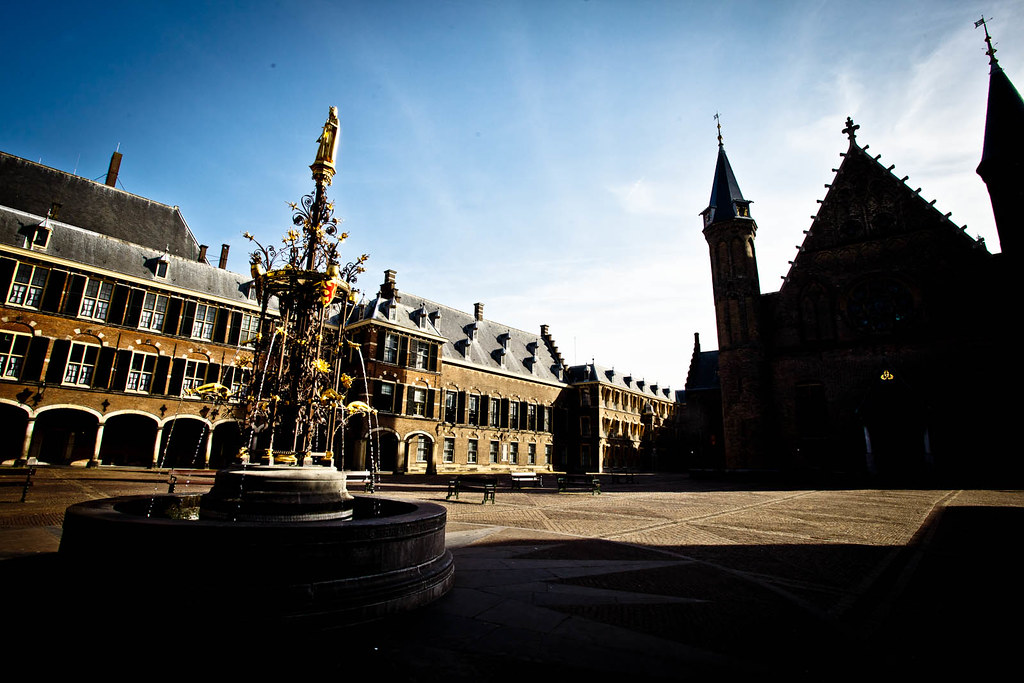
  4. You say Binnenhof,  I say Buitenhof, They Say Hofijver, We all say Parliament - One of The Hague's most famous landmarks is its parliament complex. It has a pond in front and is the location of the original Count's Hedge ('s Gravenhage). The Binnenhof, what I incorrectly call the picturesque building, literally means inner courtyard, not the building as I refer to it. Hofijver is the moat in front of it. Buitenhof, the courtyard across the street. It is best to call the whole place parliament. Another bad name, The White House, see 1. above. Pick something comprehensive, that describes the whole location.
    The actual Binnenhof, (photo by lyzadanger)
    1. Minimize the g's and therefore the growling - If I tell people I live in Amsterdam, they immediately picture where I live: windmills, canals, red lights, and non-stop dance parties. If I say 's Gravenhage, they say "Bless you!" I have a hard time with the letter "g" in the Dutch language. In most cases, it has a throat-clearing, growling sound that immediately betrays you as a non-Dutch native when attempted. When you rebrand your city, try to keep these to a minimum. An exception, Gouda, synonymous with tasty Dutch dairy products, is fun to say in English. As in "Have a Goud-a day!" Caution, in Dutch it is pronounced more like "HCCKKH-ouwt-ehh". If you say "Good-a" no one will know what you are talking about.
    2. Pick a name that sounds the same in multiple languages - French for the Netherlands "Les Pays-Bas", Spanish for the Netherlands "Países Bajos" or "Holanda".  All of which connote "low lands" in their respective language. This compounds people not knowing where you are from if you say "The Netherlands." because it sounds nothing like your native language. Hence, I sometimes say Amsterdam, even as we are about 60 km from there. Better to choose a name like Caracas or Kodiak. No translation necessary.


    Here are some trivia questions to further illustrate Dutch branding issues: 


    I. Which one of these name is the original name for The Hague?
    1. t' Hetogenbosch
    2. Des Graven Hage
    3. Haag
    4. Heerhugowaard
    II. True or False If you are from The Netherlands you are Dutch
    III. True or False If you are from The Netherlands you are from Holland
    IV. True of False If you speak Dutch, you also speak Flemish and vice versa
    V. What territory used to be part of Holland?
    1. Flanders
    2. Wallonia
    3. Zeeland
    4. Zealand

    So the next time you drain a part of the north sea or create you own city, why not choose something that is easy for Dutchmen and non-Dutchmen to wrap their mind around? My suggestion Flavoland (as in Flavor Flav o'land).


    Answers: 
    I: 2., II: True, III: True and False Holland is an easter, low-lying, sub-area of The Netherlands. Amseterdam and The Hague are in Holland. After all, people in The Netherlands living outside Holland do not like people saying they are from Holland., IV: True, Dutch and Flemish derive from the same root language, V. Flanders is the Dutch/Flemish speaking part of the dysfunctional country of Belgium.

    2011-05-16

    Eurovision - Where American Idol, The Olympics, and Geopolitics Collide

    The Hague, The Netherlands

    If you had asked me one week ago: What is Eurovision? I would have guessed that it is the name of a television network in France that produces a steady stream of the French equivalent of Telenovelas. I would have been totally wrong. It is, in fact, a musical performance contest where 43 countries compete for 25 slots in a 3 hour performance broadcast live this past Saturday night from Dusseldorf, Germany. It has been going on for 56 years. All 43 participating countries get to vote for the winner out of that group of 25. (You might be asking: "43? Are there really that many countries in Europe?" Well, yes, there are more than that, if you throw in Israel, Russia, Vatican city, and San Marino (just kidding about Vatican City, they did not participate this year).


    In case you missed it, the song contest is an entertaining evening of music, costumes, dance, and light displays. The performers are closer to N'Sync and Ke$ha than anything else, but PG-rated. There were some very good acts and some oddities. We enjoyed Bosnia Herzegovina's kitschy cold-war-folk-rock-performance, Estonia's discordant pop-song, hard rocking Georgia, and a festive Spanish performance. In a rare Eurovision moment, Lena, the comely winner from Germany last year defended her title in an enjoyable performance. We were laughing at the French's opera singing heat throb and Greece's spoken word + off key Gregorian chant/opera + ionic columns in the background (side note: honestly ionic columns! Greece should invest some of the bailout money on R&D in coming up with a new type of column). None of the bands we thought were going to do well, except for BH, placed high in the voting.

    Eurovision is truly unAmerican in the sense that it runs for 3 hours on public television, without commercials, and the voting of each country is revealed live at the end, country by country. It is truly American in the sense that almost the entire show is in English, which makes it very easy to watch. Votes are 50% popular, 50% by a committee from each country. There must be a lot of criticism about the voting because the hosts defended it a few times by saying "It's how we have always done it." Also,voting is like the U.S. Senate, that is to say strange, because Andorra and San Marino has the same voting strength Germany and France. Countries tended to vote for their neighbors and conspiracies abound.  I went to bed as the votes of 43(!) countries were tallied.

    Azerbaijan, The Eastern part of "Eastern Europe"


    In the morning of the following day, I learned that Aizerbaijan took the title, in a surprise to rest of Europe. Bordering Iran and normally known for its "strong women's volleyball", "adept chess players", and above average "performances on Russian quiz shows", Azerbaijan's attractive duet had memorable white costumes. In fact, that's all I can remember of their performance. As the winner, Azerbaijan has the honor of hosting next year. Given the estimated cost of 30 million euros to put on such an event, Greece, Ireland, and some of the other countries were probably relieved that they did not win.

    There is a lot of geopolitical analysis, naval-gazing, and tea leaf reading that goes into the contest. Just do a search  on Google and you'll see headlines like "Ireland pins bailout hopes on Eurovision" or "The Netherlands did not make the finals for the third year in a row, Parliament investigates", etc. All the self-examination is probably the most strange and least enjoyable bit of the extravaganza.

    Bottom line, Eurovision probably does do more to help countries cooperate than foster, counter-productive, nationalistic sentiments. Like the Olympics, it probably does little net good or, at worst, little harm to have the contest for a region that has had countless wars over the past thousand years. I'll certainly be paying more attention next year to see how Azerbaijan puts on the show and looking forward to the zany costumes and back drops!

    2011-04-30

    Tip: 6 Ways to Circumvent NYTimes' Paywall, For Now

    The Hague, The Netherlands

    Today is the last day of April, and if you're anything like me, you are saying "Thank Goodness!" because you hit your twenty article limit on nytimes.com on April 2nd and you are forced to adjust for the remaining 3.5 weeks. In the second full month of their new implementation, I have run out of article quota very quickly. While you try to sell me on why I should buy a subscription (or not read the NYTimes) instead of viewing their advertisements, I will tell you about all of the different ways you can still view the nytimes articles without having a subscription.

    Their pay wall is predicated upon being able to store cookies in your browser and giving access to articles from search engines like Google. That means you can use the following techniques to still view articles:


    • Go Incognito - Specifically for Google's Chrome browser, if you right click on the link for the article you would like to read, Click on the "Open link in incognito window" you will be able to read the full article.
    • Use a RSS Feed Reader - Set up something like Google Reader and start adding NYTimes RSS feeds. For example, if you copy the "Bucks" blog URL and paste it in the appropriate place in your feed reader, you can launch the articles from there. In general, this is a good way to keep track of sections you like to follow regularly in the paper.
    • Use Different Browsers - Firefox, Internet Explorer 9, Opera, Safari, etc. they are all good now. Since they all of have separate cookie jars, you can build up your quota on each one.
    • Go to Articles via Search Engines - I use the NYTimes for a lot for high quality recipes. They are usually well tested and have good stories that accompany them. If I am looking for a kale recipe I type "site:nytimes.com kale" in the search box. This will search only nytimes.com for articles with "kale." Clicking on these links will allow you to view the article even if you have maxed out your limit. Google News will also provide links that will take you there.
    • Go Mobile - This is similar to using different browsers but I find that I read a lot of articles my phone
    • Disable Cookies - Most browsers have a setting where you can disable all cookies. You probably won't be able to login if you have registered with a site and this might interfere with other sites where you do want to store cookies so do this in one of your browsers and use it for browsing the news.


    Even with these work-arounds, I find myself going to the Times less and less and other lamestream news sources more. Other news outlets are probably loving the Times' decision. I doubt that the Times is going to be able to stick with its current model. I don't like it but I think the WSJ model of selectively locking articles is much better. We'll see how it plays out.

    2011-04-13

    Travel: Behind the Scenes with Rick Steves on Italian Dining

    Italian Restaurant Food vs. American Restaurant Food

    The Hague, The Netherlands


    Those of you who have traveled with me know that I travel like a 57 year old woman: 3 star hotels, early dinners, and Rick Steves' travel books. Mix in our trip to Rome and I was very interested when I saw this recent article in the Seattle Times where RS talks about his experience with Italian restaurateurs and their take on American food.

    Not surprisingly and somewhat deservedly, there is a lot of criticism of portion sizes and huge dollops of overly sweet bbq sauces and salad dressings. I find this criticism mostlly unfounded and I won't bother going into the undercooked pasta dinner we had in Italy at Rick's say-so (trust me, not al dente). Interestingly, he gives a glimpse of how he reviews restaurants. That is something I always wonder given travel writers must have short deadlines and limited time in each neighborhood or city.

    Let me know your favorite travel guide writers/publishers or the best place to get travel tips.

    2011-04-11

    Travel: Panorama Mesdag in The Hague, The Netherlands

    The Hague, The Netherlands

    The Panorama itself is tucked behind the Hilton Hotel in The Hague
    There is a cool piece in the Wall Street Journal about the Panorama Mesdag in The Hague, The Netherlands. Maggie blogged about it back when we did our Amazing Museum race. It is well worth a stop. 

    Admission was included with our Dutch Museumkaart and I think we even had one of the little promotional cards for a free coffee. Look for that at the VVV when you pick up your free Hague map and then head over to the panorama. It is in between the Centrum and the Peace Palace. 

    If that is not enough. There are a number of other works by Hague School artists and a great set of post cards to collect in a tidy little gift shop. 

    Yet another thing to do when you visit The Hague!


    2011-04-05

    Tip: Using Regex to Find and Replace Two or More Spaces in Text

    To find and, perhaps, replace text with two or more spaces use the following regex:

    /s/s+

    You could use this in Notepad++ or Excel along with just about any programming language.

    Regex (Regular Expressions) are one of those techie things that are everywhere (e.g. Excel) but you never use unless you're are a serious nerd (and I mean serious). In order to remain cool, I have avoided their use. However, recently I have been scrubbing large text files and I decided it might be faster if I caved and used a regex.

    Regex is a syntax or language for manipulating text or strings. For example, you might remember Microsoft DOS commands like "dir *.*" that would list all files with any filename or three letter extension. Regex is similar (not exactly the same) to shell commands like that.

    In my quest to become a nerd, I found that the support documents are not for novices. Send me some comments if you know of some good sandboxes for building regex.

    2011-03-25

    Q3: What Do You Do All Day?

    The Hague, The Netherlands

    One of the most common questions I got when I visited The States over the Christmas Holiday (now three months gone) and continue to get is "What do you do all day?" Even Maggie, who observes me the most, asks from time to time (Danger!). The funny thing is, and most people who are in my position say the same thing to me, the more time you have the easier it is to fill. I have had three things I have been focusing on:

    1. Developing Business Ideas - A big reason for me to take a year off from work
    2. Learning a Second Language - One of the few disadvantages of my generation of being born in the United States is not having exposure to a lot of different languages growing up
    3. Health - With the stress of work and comforts of a joyful relationship, my weight increased and blood pressure was borderline

    Scoring myself against those goals, I think I have had mixed success. In the business department, I have not made my first $1000 yet, but we did launch an alpha version of our first mobile app two weeks ago (SpotPad). WRT de-monoglot-onizing, I feel better about my Dutch everyday and I am almost, almost finished with Rosetta Stone. Finally to my health, I have not measured my blood pressure recently but I have lost 20 pounds and have become a healthier cook at the same time. 

    All in all, it has been a great, almost, six months in the Hague!

    2011-03-07

    Verblijfsdocument Succes! (Residence Permit Success)

    The Hague, The Netherlands

    The slim envelope arrived Saturday telling me my Dutch residence permit was available for pickup! Abnormal these days, today I left the house before Maggie, and pedaled my bike up to the government building we have visited on a few nervous occassions in our quest to get me a residence permit.

    The renovations they were making to the original lobby were completed. The IND removed their institutional, fiberglass "1 person per seat please" chairs and added a number of ultra-modern lime green sofas. I settled in for a long wait as the room was packed. I reviewed my Dutch vocabulary and after no more than five flashcards they called my number. I got my residence permit card! (It has the absolute worst picture ever taken)

    The sky was crystalline blue and I pedaled away from the IND as if I was sixteen years old with my drivers license in hand, headed to my super sweet sixteen party filmed by MTV. (Of course, we had a "Super Residence Permit to party" party with our friends and neighbors yesterday to celebrate and I did not arrive by litter but I was grateful to our friends for celebrating with us). I rode my bike the long way home acting like I owned the country, and immediately transfered all of my belongings to a new wallet, no longer being required to carry my passport and visa around everywhere.

    It is such a small thing but it removes a huge amount of uncertainty for Maggie and me. It also means we can make plans for next month without having to worry about me being forced to leave the country suddenly or applying for transit visas. I am looking forward to Spring in the Netherlands!


    2011-02-28

    Article: Maastricht Travel Writing Awesomeness

    Den Haag, Nederland

    Maggie wrote what critics (me) are calling a "must read" entry on our recent trip to Maastricht. Focus is on the downs and ups of travelling in the off-season. She may have low-paid career in travel writing ahead of her!

    Enjoy!

    The familiar Dutch train system sign on Maastricht Centraal

    2011-02-25

    Tip: How to Setup Shortcuts for Google Translate

    Being so bad at Dutch, I do a lot of translation from Dutch to English and vice versa. With so much translation between two specific languages, I find that it pays to create bookmarks that pre-load the languages I want. It's simple to do in Chrome, or any browser.


    Here's how:

    1. Go to Google Translate (translate.google.com)
    2. Set it to the languages you commonly use (e.g., English and Dutch)
    3. Leave the textbox blank and click "Translate". 
    4. Your URL should have something like "#en|nl|" with the two letter language codes you want at the end of it separated by "pipes" (usually SHIFT+\)
    5. Create one bookmark in your browser where the URL is "translate.google.com/#en|nl|" and the other is "translate.google.com/#nl|en|" and name them something like "English to Dutch" or "English->Dutch" etc.
    6. For extra credit, you can add it to your "Bookmark Bar" so that it is always accessible


    As a heavy user of Google Translate over the past few months, I usually notice when Google introduces new features to translate. Here are a couple more tips and tricks for Translate:


    Translate Emails - Turn on message translation inside Gmail. Go to Google Labs (you have to enable Labs if you have not already). This way you can get those Groupon messages from Bogotá and easily translate them from Spanish to English and then jet in for the weekend. Be wary of turning on too many of those Labs things. I think it slows Gmail down.
    Alternate Translations -  Point your mouse on the word to figure out what original word or phrase is associated with it (highlighted in yellow). When you get your translation, click on the translated word for alternate possibilities. This gets pretty hairy with long documents


    I am, albeit behind, three quarters of the way done with Dutch Rosetta Stone. I'll update on that soon too.

    Succes!

    2011-02-22

    Dutch Immigration Update (2/2): Not Bad News

    The Hague, The Netherlands


    Cracking the Dutch Immigration's Code

    Last week we got a letter from the IND (e.g., Dutch INS) requesting more information about my business. This was neither good news, at least, the news we were hoping for, nor bad news. The IND requested a certification of my bank accounts from a registered accountant and simple set of opening financial statements. This was relatively simple set of documents that required a bunch of leg work to secure and some misadventures in speaking Dutch.

    The request gave no further information about when we should expect a response. We are rounding out the three month mark since I submitted my application. This was when the agent said we should expect to hear something. We were warned, however, as a result the international treaty under which I applied, it could take longer. The visa I was issued still allows me to stay until May so we *still* feel pretty good about the whole process.

    I do still feel like I have applied to college and I am waiting to hear. The question is, should I be hoping for a thick envelope or thin envelope? The last one was very thin and caused a lot of distraction. I am hoping the next one has a greencard.

    2011-02-13

    Q2: Coffee Shops without Koffie

    Maastricht, Nederland


    Some of the most common questions I received while I was back in the States over the holidays were about illicit substances in The Netherlands. A random sample:
    • What aisle at the supermarket has the cannabis? Herbs and spices? Produce? Floral? (Answer: It is only sold at “coffee shops” or Smart shops)
    • Is it permissible to smoke a hookah on the subway? (Smoking in a public, closed areas is illegal)
    • Do people give marijuana plants instead of poinsettias during the holiday season? (No, they often give homemade gifts or write funny poems)
    Seemingly, Dutch people pride themselves on tolerance and openness as a society, but, this is not precisely why The Netherlands “tolerates” drugs like cannabis. As many of you already know or experienced for yourself, The Netherlands allows the possession of “soft” drugs, like cannabis. While still technically illegal, possession of up to 5 grams of cannabis is not prosecuted. However, the Dutch government considers heroin and cocaine “hard” drugs, prohibits their possession, polices, and prosecutes them aggressively. Instead of prosecuting the problem as a criminal issue and pushing the practice underground, the Netherlands tries to treat the problem from the demand-side as a disease. In this way, most Dutch believe that drugs have a “negative” impact on society and should be avoided. Consequently, the Dutch have very low levels of use and addiction.

    “Coffee Shops” sell cannabis and also allow you to smoke inside. I know of three in The Hague including the two on our block. It is illegal to promote the sale of cannabis, hence these places are called “coffee shops” or “tea houses” and are harder to spot (which is why I probably only know of three) Incidentally, if you want to buy a coffee (koffie), go to a “cafe” because the Coffee Shops pretty much only sell cannabis and hashish and accessories.

    The two Coffee Shops on our block are depressing places. There are very few windows, through which you can see dozen chairs surrounding a couple fold-up picnic tables with ashtrays on top. The sidewalk outside reeks of marijuana and marijuana smoke. They are little more than drive through drug dealers. I hate to be a no-fun-nik, but it does lead to a lot of sketchy people on our street and alters, somewhat, an otherwise quiet neighborhood on a canal.

    “Tolerating” marijuana also creates a lot of ironies:
    Thank you for not smoking (tobacco) – like the rest of the West, tobacco smoking indoors is strictly prohibited. This means no tobacco smoking is allowed (technically) inside marijuana-smoke filled coffee houses. This presents a small problem because most people mix their cannabis or hashish with tobacco. In the one “less-sketchy” coffee shop in the centruum, they have a “smoking” section, where you may smoke a cigarette. Seating is limited to two persons.
    Please Report Plantations - There are campaigns to identify and shut down “cannabis plantations.” The town hall will even provide you with “scratch and sniff” samples so you would know how to identify one. According to the brochure, growing large amounts of pot indoors is dangerous because it can lead to electrical fires and wastes water. No mention of the health dangers of the extreme consumption of Cool Ranch Doritos and Mama Celeste frozen pizzas.

    Like many Western governments in recent years, The Netherlands has tilted to the right of the political spectrum. This conservative bent has given more weight to the parties who would like to increase restrictions on sale of drugs. For the past few years, due to pressure from large E.U. neighbors like France and Germany, Dutch governments (regional and national) have been trying to limit the sale of illicit drugs. For example, Maastricht, a Dutch border city we visited, ratified a law forbidding sale to non-Dutch residents. This creates a host of interesting questions because many E.U. Citizens believe that they should not be denied rights if they immigrate to another E.U. country. This will be interesting to see how it plays out as it winds its way through Dutch and E.U. courts.

    My takeaway is probably no surprise to you. While I am not a smoker or a toker, this approach seems “neater” than criminalizing the behavior and pushing it underground. Besides, the results speak for themselves. The Dutch have fewer people who smoke pot less often (arguably) and with much much less violent crime and that is hard to argue about.

    2011-02-07

    Q1 - Kafka's Greencard (Visa Update (1/2))

    Den Haag, Nederland


    Many of you have asked what my visa status is. I appreciate all of the concern and I am grateful for those of you who helped with the visa application. I still have not heard anything, and this is definitely a “no news is good news situation.” Currently, I have a 6 month temporary visa whilst awaiting the decision on my application. We would be able to appeal, should I receive a “NEE!” from the Dutch Immigration (IND). Also, some nice people we met who work at the UN have said we should contact them before I leave the country. We feel like have solid backup plans in any case.

    (Here is a longer, Kafkaesque story about applying for a residence permit in The Netherlands)

    It's good to be lucky. The Dutch visa process continuously reminds me of that. I won an ovarian lottery long ago. It was not due to any work or risk-taking on my part. This is both funny and sad at the same time. When I attend my various immigration appointments, I remember (and promptly forget) what a luxurious position I am in. The people  waiting in queue at these government offices have desperate, tired looks on their faces. I can afford to be annoyed at the bureaucracy. They cannot.

    Several weeks ago, I received a registered letter from the city government that said I missed an "integration" appointment and that they took the liberty of scheduling a new appointment. Also, the letter stated I could be fined if I missed this new appointment too. The letter was written only in Dutch and something was lost in the translation that Google provided. It did not explain what "integration" was nor whether or not my application for a residence permit had been accepted or rejected. The letter stated that I had to bring all my documentation (e.g., passport) and that I should not miss the appointment. I hoped that the appointment might shed some light application I filed with Dutch immigration two months earlier.

    I arrived, gave the receptionist my appointment letter, and they directed me to the waiting room, where there were a lot of hopeful families waiting in queue for some positive outcome to their own meeting. The female agent who called my name was young, had dyed-blond hair, and had a round face. I introduced myself in pidgin Dutch, she had a quizzical look as if she was straining to understand my accent. I caved and I asked in Dutch if she spoke English. She frowned and said “Yes.”

    Once we sat down, she asked me very sternly, in English, why I missed the first appointment, whether or not I knew how serious the Dutch “integration” requirements were, and if I knew what the integration law was. I answered all questions with a sincer “no” and apologized for missing the first invitation. I learned that the Dutch Immigration law, passed in its current incarnation in 2007, requires non-EU immigrants to take Dutch language courses and learn about Dutch culture. “Perfect!” I thought as I must have had an excited look on my face at the prospect of free language and history courses.

    She then asked for my “green card.” I replied that I did not have one yet. Her eyes widened and she asked “why not?” I explained that I have a temporary stamp in my passport that allows me to stay for six months while the IND processes my application. She asked where I was from and for my passport and I told her I am “American.”

    Immediately, her steely exterior shattered and she became visibly agitated. She stumbled to get out her next request for my paperwork. She then blurted out something like “I am very nervous about my English, I don't normally speak with native English speakers.” I told her not to worry and that she speaks perfect English, like almost every Netherlander I encounter.

    She then looked in her database at my records, and she saw that my Dutch residence permit application is still in “procedure”, which means “no decision” from the IND. Then she told me that I was mistakenly sent the letter for this appointment and that it would be unlikely that I would be eligible for the integration classes and that I should call prior to returning, even if I receive an appointment notice. It appeared I, once again, had broken the system as an American. It must be a rare thing that a U.S. Citizen immigrates to the Netherlands in South Holland without a company sponsored work permit or other exception. I feel like an out-lier at all of these appointments.

    The whole appointment took no longer than ten minutes. As I walked out I saw some of the people who angst-fully waited in the lobby with me. Perhaps they missed their first appointment too. Their officials still had stern looks on their faces and the discussions appeared tense. I promised it would would take me longer to forget my lottery winnings this time.

    Only Three Questions

    Utrecht, Nederland

    January was “Know Your Nethers” month for us. Three weeks ago we went to Haarlem (highly recommended by me), I took a self-guided bike tour to Delft, and two weekends ago we were off to Maastricht. Maastricht is the most remote part of The Netherlands you can go. The long train ride gave me some time to reflect on my visit back to the States over Christmas.


    It was really good to be “home” but I missed being in The Netherlands more than I thought I would (although, I should not confuse missing Maggie with missing the Netherlands). While home, I was able to catch-up with my family, see my niece, and see a few friends (fewer than I would have wished). There were three questions I received while I was home, I think I can paraphrase them thusly:
    1. What is your visa status?
    2. What about the drugs...?
    3. What do you do all day? (Questions two and three were normally linked)

    I will update each one with a blog post this week.

    2011-02-02

    Photos: Eurotrip, First Quarter

    Den Haag, Nederland

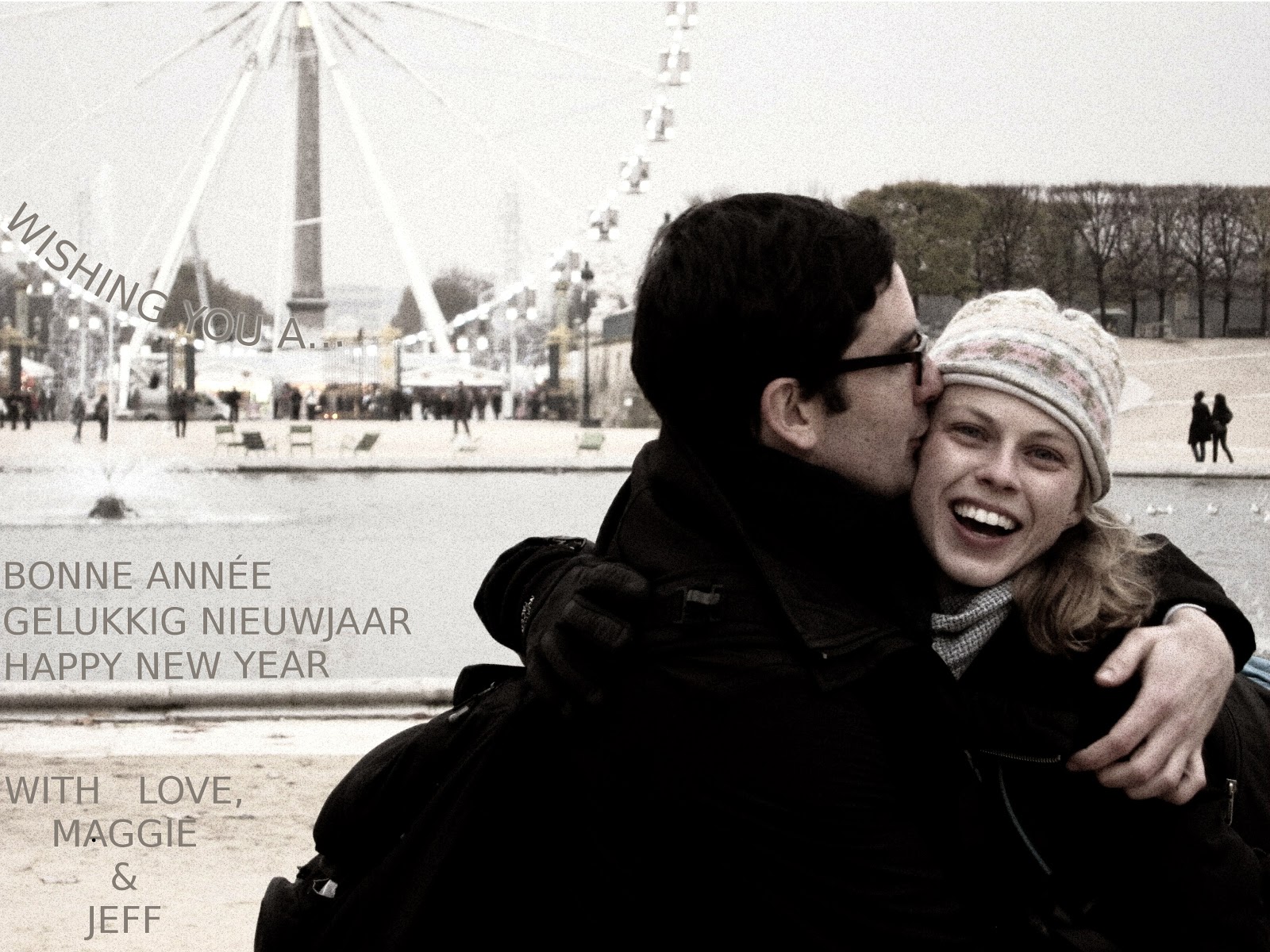
    We meant to send this image out on New Year's day (Notice all the time I spent in GIMP making the "Wishing you a..." curve to the ferris wheel). The best laid plans...


    That reminded me that I wanted to post some of the photos we had taken since we moved to The Netherlands. Enjoy!

    LUXEMBOURG
    COPENHAGEN
    BRUGES
    PARIS
    NETHERLANDS